
TL;DR
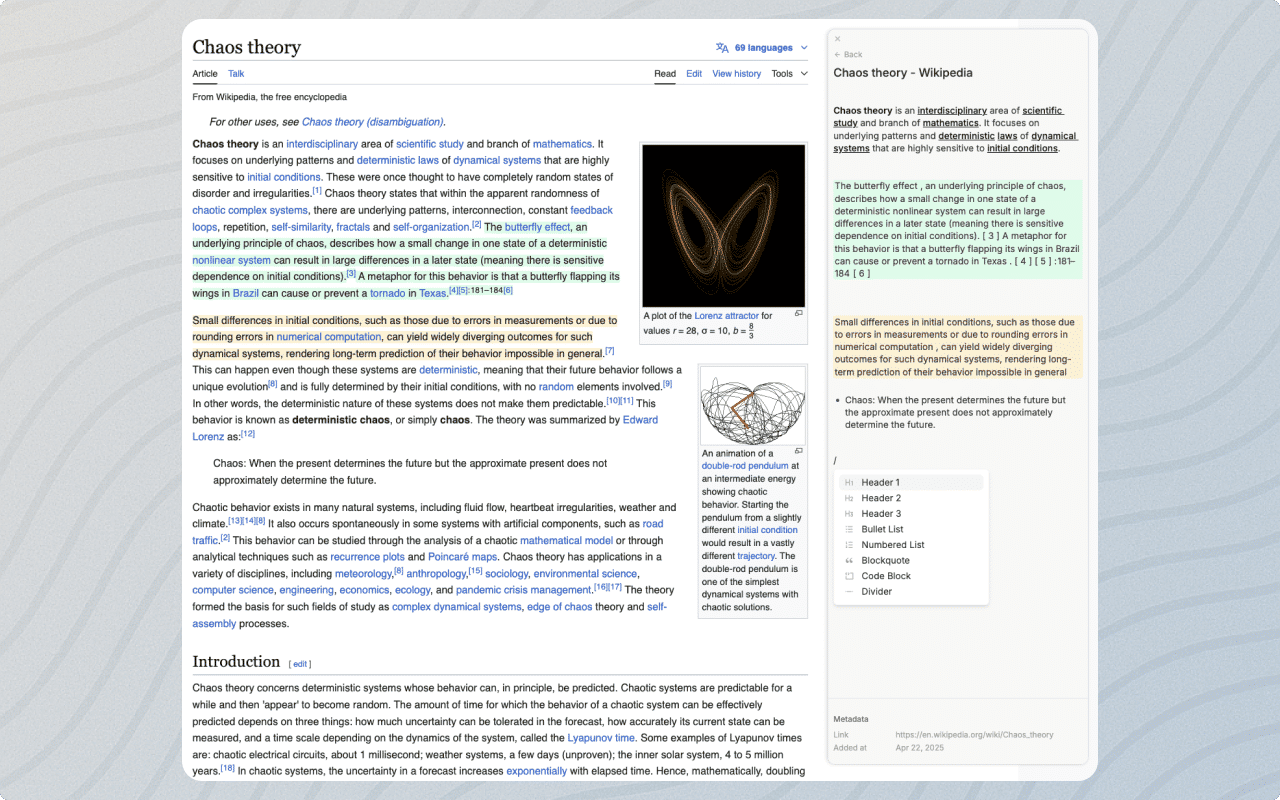
MiniReader started as an evolution of QuickPad — a markdown notepad Chrome extension — into a smarter reading tool that automated the Read → Note → Store workflow. We built it for ourselves, never launched it publicly, and stopped after about five months when the ROI stopped making sense and the market shifted underneath us.
The Problem
As a heavy reader, I was losing too much time on friction between reading and note-taking: switching between browser and Notion, manually copying article titles and URLs, reformatting notes, saving to my knowledge base. The cognitive interruption was as annoying as the time cost.
QuickPad — a side-panel markdown notepad my co-builder had already built — solved part of this. But it was generic: a note-taking tool for anyone, competing in a crowded market with no real moat. The opportunity I saw was narrower and more specific: automate the full reading-to-knowledge workflow for people who read deeply and save everything.
What We Built
-
V1 — MiniReader Extension: A Chrome extension that auto-extracted article metadata (title, URL) when you opened a note, let you highlight text directly into your notes, and supported markdown with Notion-style
/commands. One-click copy of all notes in markdown format to paste into Notion or Obsidian. -
V2 — MiniReader App: A browser-based app with the extension as the entry point. Deeper reading experience, YouTube video support with transcript access, AI-generated article summaries, tag-based organization, and Google login to sync between extension and app — which also gave us a way to convert anonymous users into identified leads.
Three months to build V1. About five months total before we stopped.
Key Decisions & What Happened
-
Starting too ambitious. We wanted to solve the entire journey from content discovery to knowledge storage from day one. That ambition caused us to get stuck on user flow and interface design — until we forced ourselves back to a true MVP and rebuilt from there. Should have started smaller.
-
Never launching. This was the biggest mistake. Without real users, we were building on assumptions about what the workflow should look like. We had no validation loop, no early adopter feedback, no signal on product-market fit. We stopped before ever knowing if we’d built something people wanted.
-
The market moved underneath us. We stopped partly because the core premise of MiniReader — a “knowledge bridge” between browser content and personal knowledge bases — started to feel shaky. If AI agents could directly read a browser tab to Obsidian via MCP, why would you need a manual middle layer? By 2025 that question answered itself: agentic AI workflows replaced exactly what MiniReader was trying to automate. The product became obsolete before it launched.
-
What survived. QuickPad — the simpler, original notepad extension — still runs and we still use it daily. The most durable product wasn’t the most ambitious one. It was the one that did one thing well and didn’t over-engineer itself.
What I Learned
- Launch earlier, even with an imperfect product — five months without real users meant five months of building on guesses
- A well-defined, narrow problem beats an ambitious vision with no clear starting point
- In fast-moving markets, validate your core premise before building the full product — market shifts can invalidate a product idea faster than you can ship
- Sometimes the right call is stopping, not pivoting
Read the full story (Vietnamese): Chuyện làm Product #2 →