
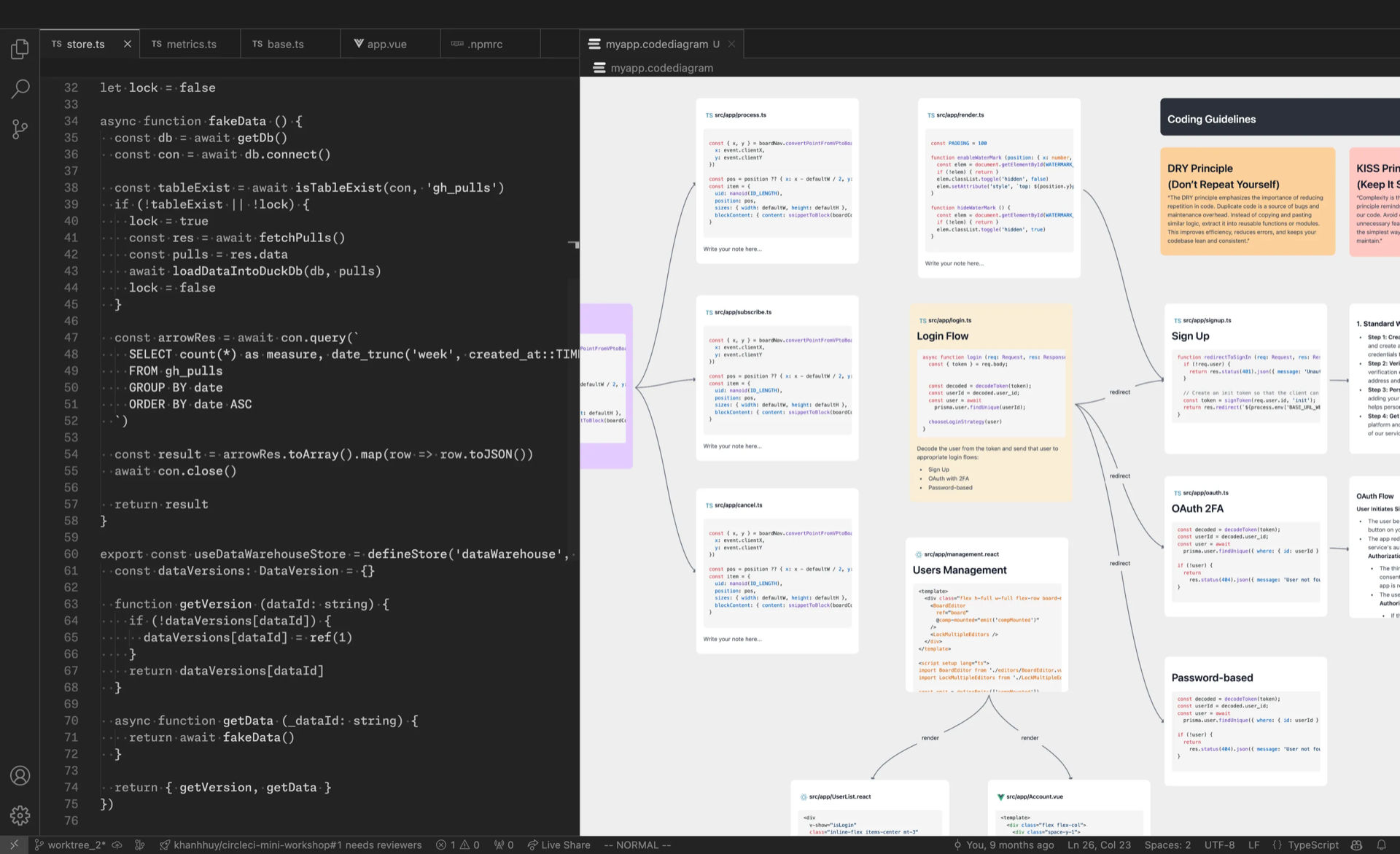
TL;DR
Code Diagram lets engineers draw architecture diagrams directly alongside their code in VSCode. We built it to solve our own problem, shipped without a launch plan, reached 18K+ downloads, and stopped active development a year later when the retention data told us the product had a ceiling.
The Problem
While debugging a complex payment system at Holistics, my co-builder and I needed to visualize code logic. Existing tools (Lucidchart, Figma, CodeSee) either didn’t integrate with the IDE or auto-generated diagrams too complex to be useful. We wanted something that let engineers curate what went into a diagram, annotate it, and navigate back to the real code instantly. Nothing did that, so we built it.
What We Built
A VSCode extension — not a standalone app, to minimize installation friction — with four MVP features: create diagram files alongside code, snip code into diagram nodes, navigate back to source files, and auto-save diagram state.
Three months to build. We launched in August 2023 without having validated the idea with anyone outside our immediate circle.
Key Decisions & What Happened
-
VSCode Marketplace first. We invested in a clean name, proper logo, and actively responded to every review. Within a year we dominated the “diagram” and “code diagram” search terms — driving ~90% of our 18K+ downloads. Strong channel, but risky to depend on exclusively.
-
Launch experiments. Our Hacker News post flopped (wrong title format, no demo, no clear problem statement). Our Reddit post accidentally worked — clear value in the title, a demo video attached — 114 upvotes and steady traffic for days after. Same week, opposite results. Every channel has its own grammar.
-
Growth loop. We built a “share to unlock” mechanism: tweet about Code Diagram to unlock multi-diagram view instead of paying $4/month. Most users tweeted. We also discovered retained users were building large diagrams to share with their teams — a behavior we hadn’t designed for — so we shipped export, shareable links, and GitHub integration. That sharing surface drove ~10% of new users.
-
Stopping. Mid-2024, retention was ~16% weekly (benchmark: 25%), dropping to near zero after 12 weeks. The product solved a one-time problem — once engineers understood a codebase, they stopped using the tool. Pivoting upmarket to teams would have required a full redesign and AI integration we couldn’t resource. We stopped. The product still runs and still gets installs.
What I Learned
- Validate with real users earlier — we learned more in the first month post-launch than in three months of building
- Retention is the honest number; downloads feel good but tell you nothing about product-market fit
- Distribution channels have different grammars; prepare content specifically for each
- Knowing when to stop is a product decision, not a failure
Read the full story (Vietnamese): Chuyện làm Product #1 →
Try the extension: codediagram.io →